Hong Kong Convention and Exhibition Centre
.avif)
.gif)



.webp)

Top category

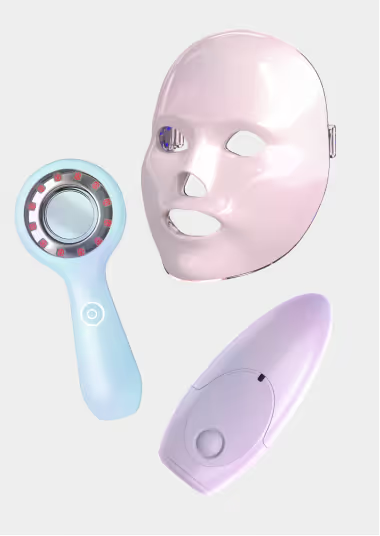
Top category


.png)
%201.svg)
%204.svg)


Parkinson's: It Starts from the Gut
New research suggests Parkinson’s disease may originate in the gut, with misfolded proteins traveling to the brain through the vagus nerve. Infrared light therapy shows promise in improving gut health, sleep, balance, and overall vitality in Parkinson’s patients.
Parkinson’s disease is a complex neurological disorder that affects movement, balance, and quality of life. While symptoms such as tremors, rigidity, and slowed motion are well known, patients often experience additional challenges including depression, insomnia, memory loss and loss of smell.
Its underlying cause remains uncertain, but research links the disease to dopamine depletion and neuron damage in the brain’s basal ganglia. Traditional treatments rely on medication to boost dopamine levels and physical therapy to maintain mobility. Increasingly, however, researchers are investigating new approaches including infrared light therapy to improve patient outcomes.
The Gut-Brain Connection
In recent years, scientists have explored how Parkinson’s may originate in the gut. The microbiome, composed of trillions of bacteria, fungi, and protozoa, has been tied to many health conditions including obesity, diabetes, cardiovascular disease, and depression. Studies show that the microbiome of Parkinson’s patients differs significantly from that of healthy individuals.
A striking observation is the accumulation of Lewy bodies misfolded proteins linked to Parkinson’s not only in the brain but also in gut cells. Researchers hypothesize that these abnormal proteins may travel from the gut to the brain through the vagus nerve, a theory supported by animal studies and reduced Parkinson’s risk in people who have undergone vagotomy surgery.
How Infrared Light Therapy May Help
Dr. Ann Liebert, co-ordinator of photomolecular research at the Australasian Research Institute, is investigating whether infrared light therapy can modulate the gut microbiome. Preliminary results from clinical trials in Adelaide have been promising:
- Participants showed up to a 20% increase in beneficial gut bacteria, linked to reduced obesity and improved metabolic health.
- Harmful bacteria associated with conditions such as rheumatoid arthritis, Crohn’s disease, and insulin resistance decreased.
- Patients reported meaningful improvements in daily life, including restored sense of smell, better sleep, improved balance, and greater energy.
One participant, after years of losing his sense of smell, was able to detect flowers and even the aroma of his wife’s cooking again. Another reported sleeping through the night for the first time in years, while others saw improvements in coordination and overall vitality.
A Safe, Accessible Therapy
Infrared light therapy works by stimulating mitochondria, the cell’s “powerhouses” to boost energy production, circulation, and repair processes. Unlike pharmaceutical treatments, it is non-invasive, drug-free, and has virtually no side effects. Clinicians already use low-level laser therapy in treating conditions ranging from Alzheimer’s and depression to chronic pain, and Parkinson’s research may soon expand these applications further.
The Future of Light Therapy in Parkinson’s
While large-scale randomized controlled trials are still needed, early evidence suggests that infrared light could represent a breakthrough in managing Parkinson’s disease and other neurodegenerative conditions. By targeting both the brain and the gut, light therapy has the potential to reshape treatment strategies.
At Light Tree Ventures (LTV), we are committed to developing ISO13485-certified and FDA-approved light therapy devices that support this kind of innovation. If your organization is exploring opportunities in neurological health or microbiome research, you can Request a Quote today. Our Private Label Options allow you to design tailored devices, while our White Label Solutions enable you to Start Your Project Today with safe, ready-to-market devices.
References
- PubMed. (2017). The gut-brain axis and the role of the vagus nerve in Parkinson’s disease. Nature Reviews Neurology, 13(11), 625–636. https://pubmed.ncbi.nlm.nih.gov/29247431/
- PubMed. (2018). Gut microbiome alterations in Parkinson’s disease: Evidence and clinical implications. Movement Disorders, 33(9), 1430–1440. https://pubmed.ncbi.nlm.nih.gov/30074108/
Your next steps start here
Want to see how our expertise can support your business? Leave your details and our team will contact you shortly.