Hong Kong Convention and Exhibition Centre
.avif)
.gif)



.webp)

Top category
Top category


.png)
%201.svg)
%204.svg)


Red Light vs Near-Infrared (NIR): When to Use Which, and Why
Red light and near-infrared light both support cellular energy and recovery, but they target different tissue depths. Understanding when to use each wavelength is essential for developing effective light therapy devices.
Red light and near-infrared (NIR) light are often discussed as if they are interchangeable. In reality, they serve different purposes within photobiomodulation (PBM). While both stimulate cellular activity and support natural repair processes, the depth at which they work makes a significant difference.
For brands developing light therapy devices, choosing the right wavelength is one of the most important decisions in the product development process. The biological target, intended application, and user experience all depend on it.
Understanding the strengths of red light and NIR allows companies to create devices that are not only scientifically sound but also better aligned with market demand.
The science behind photobiomodulation
Photobiomodulation uses specific wavelengths of light to interact with cells and support biological processes. When light reaches the body, it is absorbed by cellular structures, particularly the mitochondria. These structures are responsible for producing ATP, the energy source that powers cellular activity.
As cellular energy production increases, cells can function more efficiently. This may support circulation, help regulate inflammation, and create better conditions for recovery and tissue maintenance.
Although red light and near-infrared light activate similar biological mechanisms, their effects differ because they reach different depths within the body.
What is red light?
Red light generally falls within the wavelength range of 630 to 680 nanometers. Because it is visible to the human eye, it creates the characteristic red glow seen in many beauty and wellness devices.
Red light is primarily absorbed in the upper layers of tissue, making it particularly suitable for applications involving the skin and superficial structures.
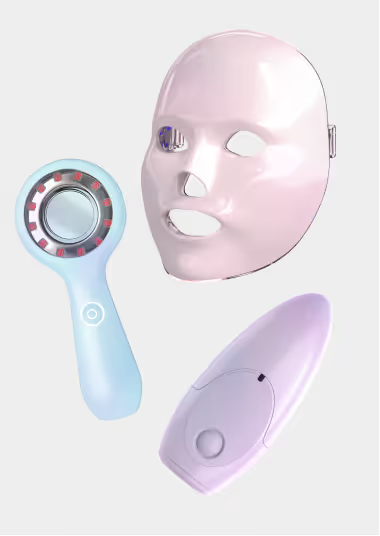
This is one reason why red light has become so widely adopted within the beauty and aesthetics market. It is commonly used in facial masks, handheld skincare devices, and professional aesthetic systems designed to support skin quality and appearance.
When red light is the better choice
When the treatment target is close to the surface, red light is often the preferred option.
Applications that commonly rely on red light include:
- Skin rejuvenation
- Anti-aging treatments
- Acne support
- Redness reduction
- Superficial wound healing
Because red light interacts primarily with skin tissue, it is particularly valuable for brands focused on beauty, aesthetics, and consumer wellness products.
For example, a facial mask designed to support collagen production and improve skin appearance will typically rely heavily on red wavelengths. Likewise, acne-focused devices often combine red light with blue light to address both inflammation and acne-causing bacteria.
What is near-infrared light?
Near-infrared light usually falls between 800 and 880 nanometers. Unlike red light, NIR is invisible to the human eye.
Many users are surprised when they first encounter a near-infrared device because little or no visible light is emitted. However, the treatment remains fully active.
The key advantage of NIR is its ability to penetrate much deeper into tissue. Rather than primarily interacting with the skin, it can reach muscles, joints, tendons, connective tissue, and other deeper structures.
This deeper penetration has made NIR one of the most important wavelength categories within sports recovery, pain management, and performance-focused devices.
When near-infrared light is the better choice
When deeper tissue support is required, NIR often becomes the preferred solution.
Common applications include:
- Muscle recovery
- Joint support
- Pain relief
- Sports performance
- Recovery and rehabilitation
- Full-body wellness systems
Athletes, recovery clinics, and wellness providers increasingly use NIR-based technologies because they can target tissues that are inaccessible to many surface-level treatments.
This is particularly relevant for recovery-focused products where the goal is to support muscles, tendons, or joints rather than the skin itself.
The practical difference between red light and NIR
The simplest way to understand the difference is to think about the treatment target.
If the goal is to support the skin, red light is usually the best choice.
If the goal is to support deeper structures such as muscles or joints, near-infrared light is generally more effective.
That does not mean one wavelength is superior to the other. They simply serve different purposes.
A skincare device, for example, has very different requirements than a sports recovery system. Choosing the wrong wavelength can limit the effectiveness of an otherwise well-designed product.
Why many devices combine both wavelengths
Many of today's most successful light therapy devices combine red and near-infrared wavelengths into a single system.
This approach reflects the reality that the body is not organized into isolated layers. Skin, blood vessels, connective tissue, and muscles all work together.
By combining wavelengths, manufacturers can support multiple tissue depths simultaneously. Red light targets the surface while NIR reaches deeper structures.
This combination is particularly popular in:
- Full-body panels
- Recovery systems
- Wearable therapy devices
- Professional wellness equipment
For brands, combining wavelengths can also create a broader value proposition by appealing to both beauty and recovery markets.
Choosing the right wavelength for product development
The most important question during development is not which wavelength is most popular.
Instead, product teams should ask:
What biological target are we trying to reach?
The answer determines almost every aspect of the device, including wavelength selection, LED placement, treatment protocols, and regulatory strategy.
For example:
- A facial beauty device will typically focus on red light.
- A sports recovery product will often prioritize NIR.
- A full-body wellness panel may combine both.
- A pain management device will usually require deeper-penetrating wavelengths.
Starting with the biological objective creates a stronger foundation for product performance and market success.
Why wavelength alone is not enough
Many companies focus heavily on wavelength selection, but wavelength is only one part of the equation.
Device performance also depends on factors such as power density, energy delivery, treatment duration, coverage area, and thermal management. A device using the correct wavelength can still underperform if these variables are not carefully engineered.
This is why successful PBM products require more than simply selecting LEDs. They require a development process that combines engineering, biological understanding, regulatory expertise, and user-centered design.
The future of wavelength-specific therapy
As the light therapy market matures, products are becoming more specialized.
Instead of generic wellness devices, companies are developing targeted solutions for specific applications such as brain health, gut health, recovery, women's wellness, oral care, and animal health.
This trend is driving greater interest in wavelength optimization and multi-technology platforms. Future products are likely to combine light therapy with technologies such as microcurrent, PEMF, vibration, heating and cooling, and app-controlled treatment systems.
The result will be more personalized and application-specific therapies designed around real biological mechanisms.
Conclusion
Red light and near-infrared light are both powerful tools within photobiomodulation, but they serve different purposes.
Red light is best suited for skin-focused applications such as anti-aging, acne treatment, and skin rejuvenation. Near-infrared light excels in deeper applications involving muscles, joints, recovery, and performance support.
For many modern devices, the most effective solution is not choosing one or the other. It is combining both strategically to create a more versatile and comprehensive treatment platform.
At Light Tree Technologies, we help brands develop advanced light therapy devices tailored to their intended application. From wavelength selection and industrial design to certification and scalable manufacturing, we support the entire journey from concept to market-ready product.
Looking to develop a red light or near-infrared therapy device?
Let’s turn your concept into a clinically aligned product built for global markets.
Start your project today.
Your next steps start here
Want to see how our expertise can support your business? Leave your details and our team will contact you shortly.